
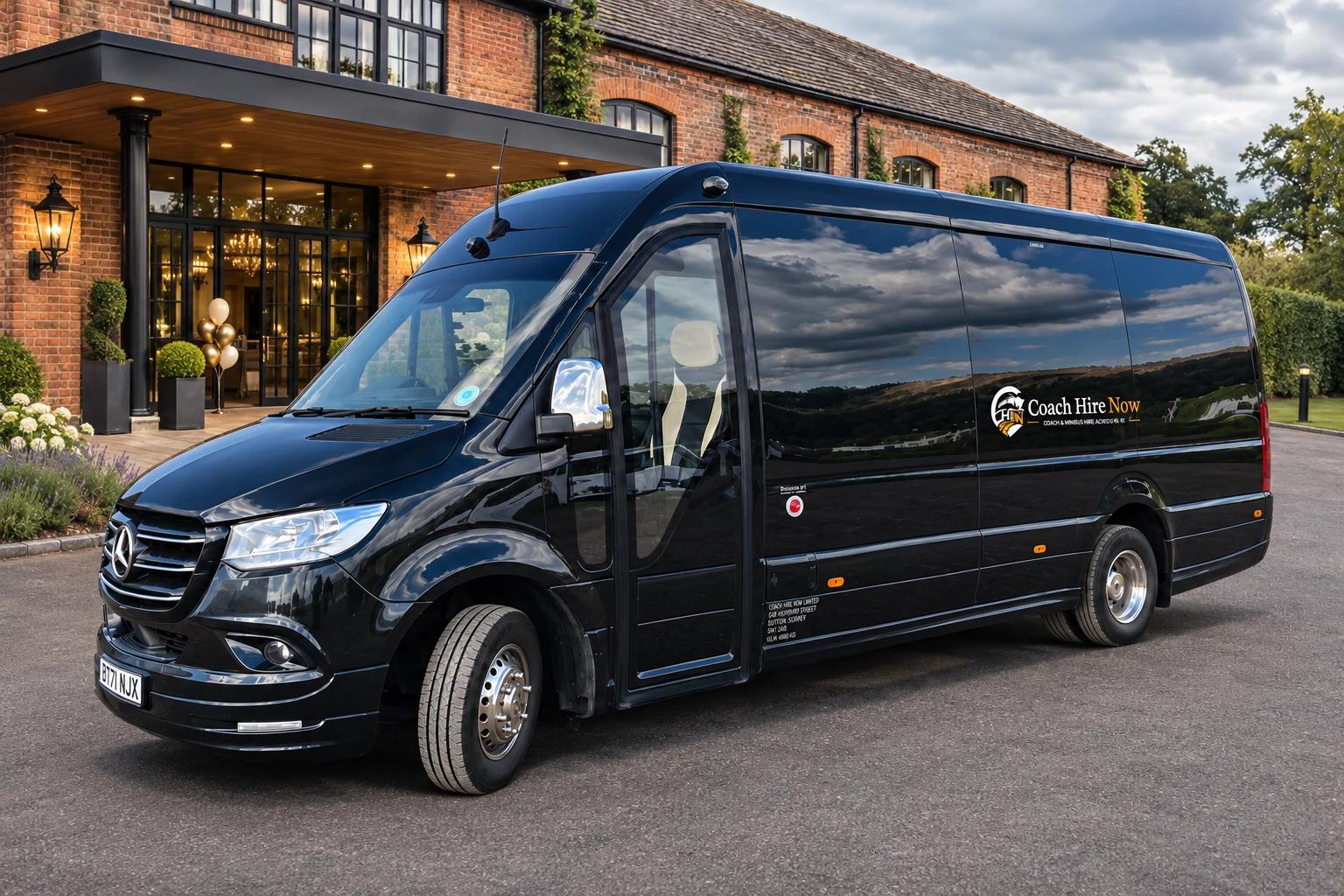
Christmas party transport by group size: minibus, midi coach or coach
Start with a firm count of who is travelling, not who was invited. Every passenger needs a seat of their own, and the seat belt rules on GOV.UK allow only one person in each seat fitted with a belt, so an extra colleague cannot be squeezed in at the end of the night. If partners or guests may come, count them now. A vehicle with two or three seats spare is far less trouble than one that is a seat short.
- Up to 16 people: a minibus. Coats and small bags are all most people carry on a night out, so a full 16 seater works well.
- About 17 to 35 people: a midi coach, which keeps the whole group on one vehicle.
- Up to 49 or 53 people: a standard coach.
- Up to 74 people: a large coach of 57, 61 or 74 seats.
- More than that, or people setting off from two sites: two or more vehicles, each sized to its own pickup.
One return time or a staggered late run
The outward trip is easy to plan. The return is where the decisions are. The simplest plan, and the one that costs least, is a single return time that everybody knows before they set out: the vehicle comes to the venue once, loads and leaves. It works when the group is happy to finish together, for example at the end of a sit-down meal or when the venue closes.
If some people will want to leave early and others will stay to the end, ask for a staggered return: an earlier run and a late one. That can be one vehicle making two trips, if the journey is short enough for it to get back in time, or two vehicles if it is not. Each extra run adds driver time and so adds to the price, but it saves the early leavers from booking taxis and stops the late ones holding everyone up.
Whichever you choose, send the return time and the exact collection point to the group in writing before the night. The vehicle may not be able to wait where it dropped you, and a group that has to be found and gathered up is a common reason for a return that runs late.
Pickup and drop-off points: why one pickup keeps it simple
One pickup point, usually the workplace or the club, is the easiest plan to price and to run. Everyone knows where to be, the driver loads once and the journey time is known. Each extra pickup adds miles and minutes, and the more stops there are, the more likely it is that one late passenger delays the rest.
The return is different, because people want to get home. Drop-offs at two or three sensible points on the way back, such as a town centre and a railway station, are usually workable. A door-to-door run for every passenger on a full coach is not, because it can add hours to the driver's night. If people live in different directions, say so when you enquire. Two smaller vehicles heading different ways can be the better answer.
December demand: why the date matters
Operators have a fixed number of vehicles and drivers, and in December much of the party work falls on the same few Friday and Saturday nights. A late finish also ties up a driver who must then take the daily rest the law requires before working again, so an operator cannot simply take one job for every vehicle in the yard. Enquire as soon as the venue and date are booked, even if final numbers are not settled.
If your date is still open, a midweek night or a date earlier in the month gives operators more room than the last weekends before Christmas. Party groups tend to need minibuses and midi coaches, so do not assume that a small vehicle will be easy to find late.
What the driver and operator need to know
Agree in advance what happens if the party runs late. Waiting beyond the booked time is charged, at a rate the operator sets, and it is not always possible at all. Drivers' hours rules limit how long a driver can drive and require breaks and daily rest, so a driver who is close to the limit has to leave. On a busy night the vehicle may also be due at another job. If you think you may overrun, book the later time from the start.
- The venue's full address and where a vehicle of your size can stop to set down and pick up. Ask the venue about narrow entrances, height limits and whether stopping outside is allowed.
- The time the event really finishes: last orders, the end of the music or the time the room must be cleared.
- The return time you want, and whether you want the vehicle to wait at the venue or to leave and come back.
- A named organiser with a mobile number who will be at the party and can gather the group.
- Any passenger who uses a wheelchair or cannot manage steps.
Behaviour, drinks on board and what to tell us
The driver is in charge of the vehicle. Under the conduct regulations for public service vehicles, passengers must not distract the driver without reasonable cause, and a passenger who is causing a nuisance can be directed to leave. Operators also set their own conditions of hire, which usually make the hirer responsible for damage and allow a charge for cleaning if the vehicle is soiled. Ask to see the conditions and pass the main points on to the group.
Do not assume that drinks can be taken on board. Whether alcohol may be carried or drunk on the vehicle is the operator's decision, and many do not allow it. If it matters to your group, ask when you enquire so that the answer and any conditions are agreed before the night.
When you enquire, tell us the date, the pickup address, the venue, the number travelling, the time you want to arrive, the return time or times, and any drop-off points on the way home. Those are the details that make the price right first time.